Mosaic EnterpriseIQ · Sovereign AI
Frontier AI, inside your own walls.
EnterpriseIQ is an assistant that answers from your organisation’s own records, on hardware you control, and shows each person only what they are allowed to read.
What sovereign means here: three things you keep
The data
Your records stay where they are.
EnterpriseIQ runs inside your network and reads from the systems you already use. Nothing is sent to a model provider, because there is no model provider.
The model
The model runs on your hardware.
Any model server that speaks the common chat API will do. We evaluated the current build on open-weight models running on a single desktop machine.
The record
Every answer can be audited.
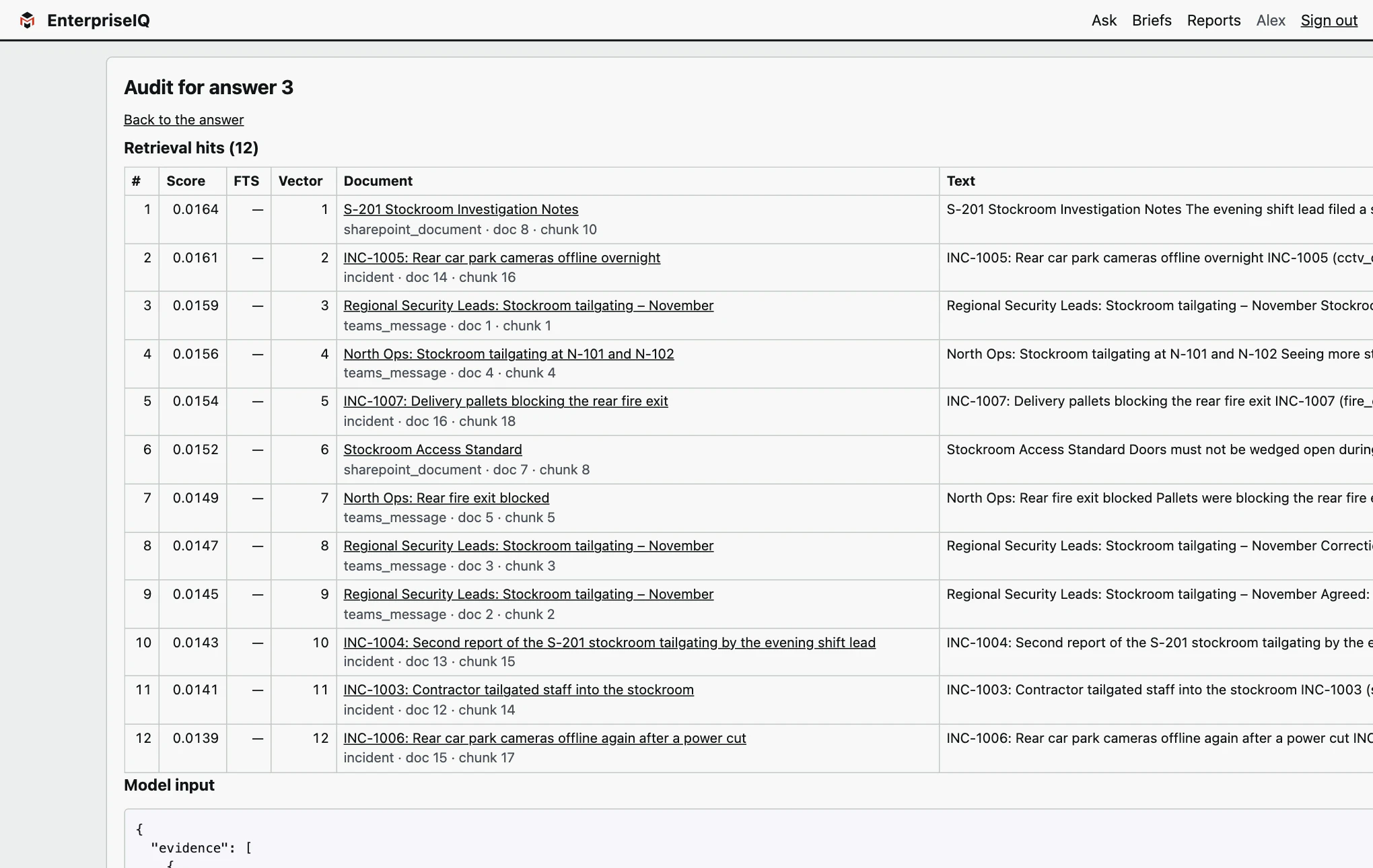
For each answer you can open what was retrieved and exactly what the model was given. If you cannot explain an answer, you should not act on it.
Becoming AI-native does not have to mean handing over the keys.
Most organisations meet AI as a service someone else runs. Their documents go out, an answer comes back, and what happened in between is not theirs to inspect. For a great deal of work that is fine. For the records that make an organisation what it is (incidents, decisions, contracts, the conversations where things were agreed) it is a real cost.
The alternative used to be impractical, because useful models were too large to run yourself. That has changed. Small open models, tuned and served well, now answer grounded questions on a single machine. That is the whole of our thesis, applied to one organisation: many precise pieces, composed, on hardware you own.
It is reasonable to find this daunting. The first deployment is deliberately narrow: one team, one set of sources, one question that matters, and an evaluation you can read before anyone relies on the answers.
What is built today.
The first release, with 814 automated tests behind it. Everything below works in that build.
- Answers only from what you may readPermissions are recorded when a document is ingested and enforced when a question is answered. Two people asking the same question get different answers if their access differs. Remove someone’s access and their next answer changes.
- It refuses to guess about accessIf a source’s permissions cannot be verified as current, that source is left out and the answer says so.
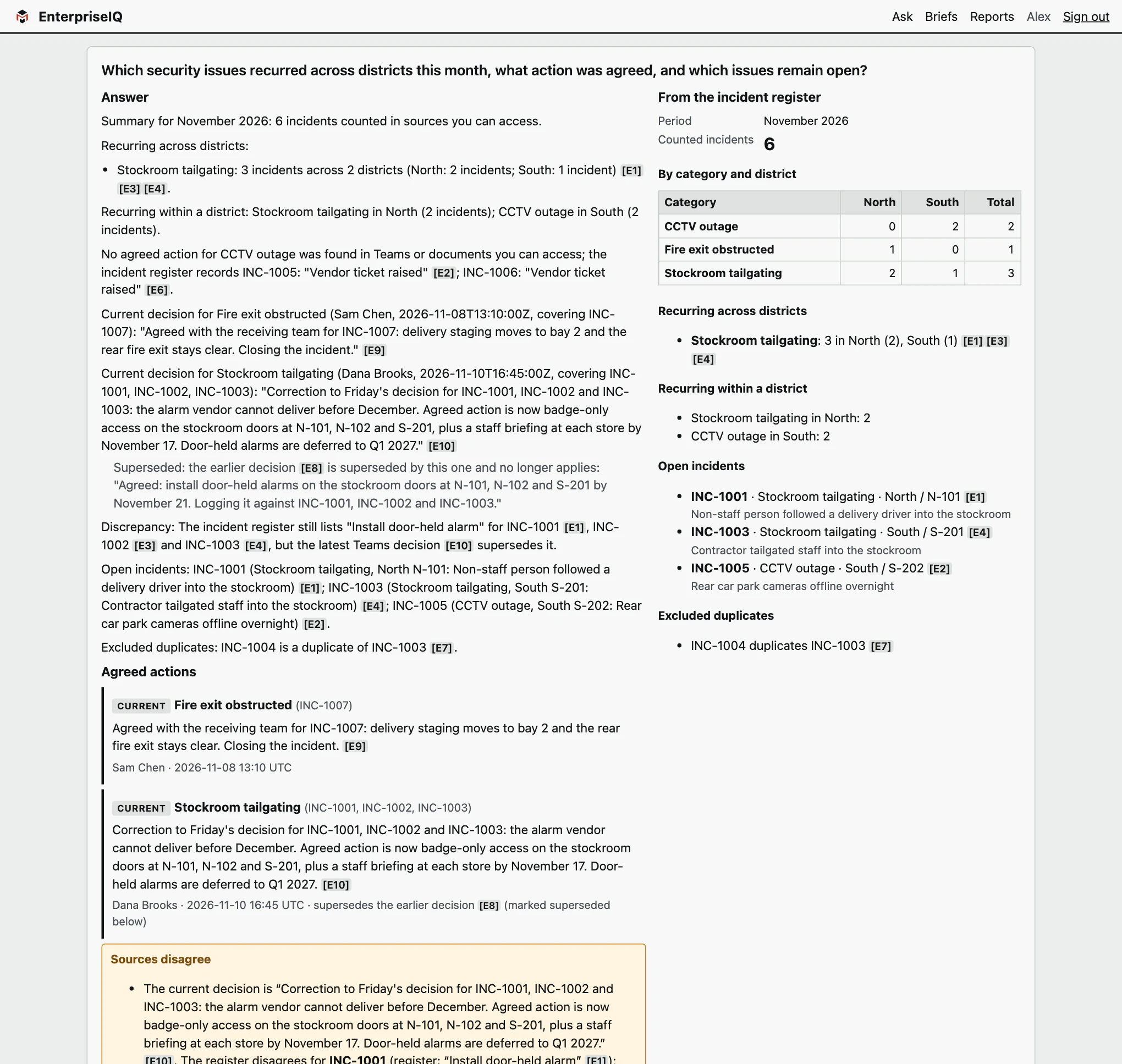
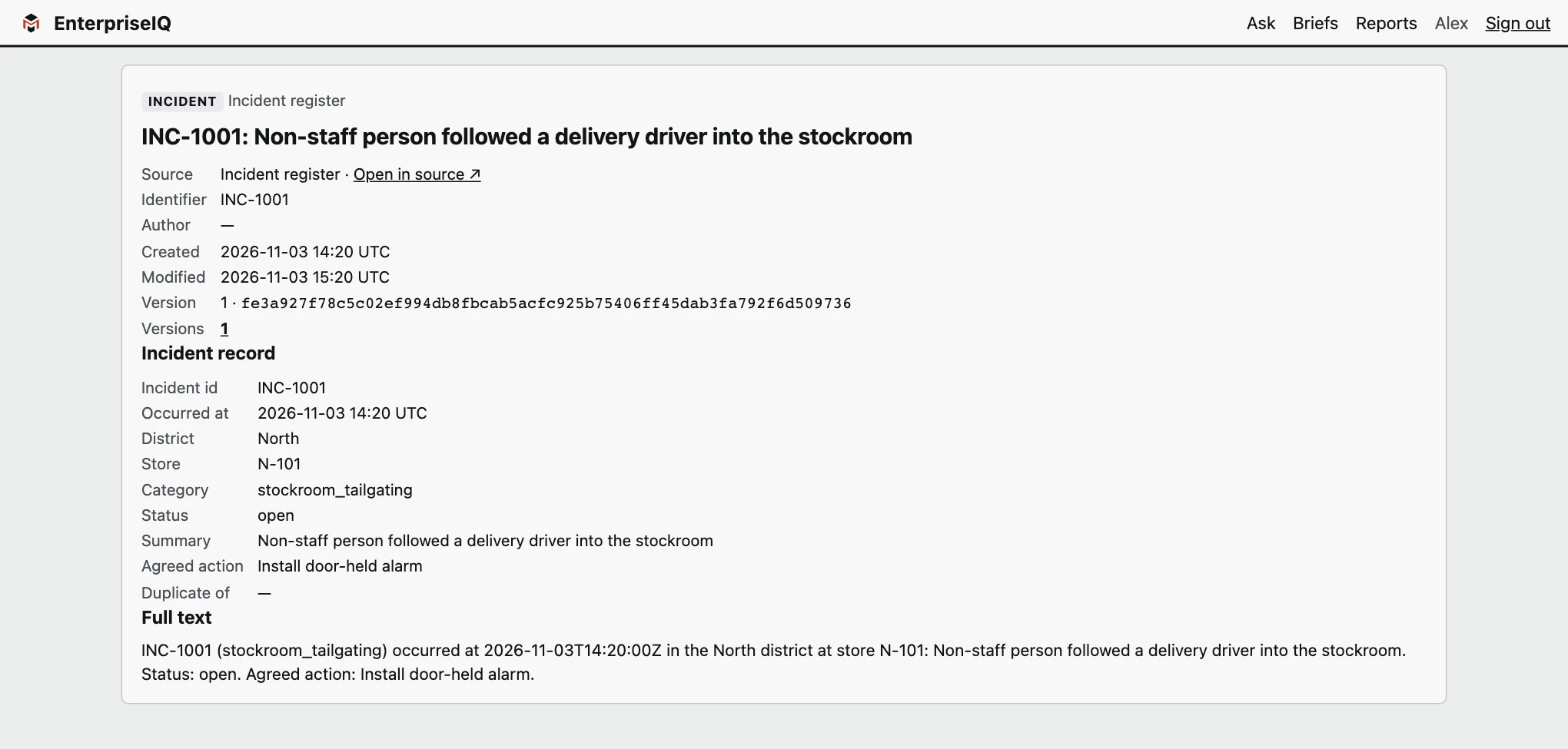
- Numbered citationsEvery statement points to the record it came from. Each record opens with its source, author, dates, version history and content hash.
- Counts come from the dataTotals are computed by queries over the records, not written by the model.
- It says when sources disagreeWhen a later decision supersedes an earlier one, or a register contradicts a conversation, the answer shows both and marks which is current.
- Briefs with a human in the loopA weekly brief is generated, reviewed, approved and only then published. A published brief is flagged if its evidence changes afterwards.
- SourcesTeams conversations, SharePoint documents and an incident register. The Microsoft connector is built and tested against recorded responses.
What it looks like.
Screens from the current build, answering a question about security incidents at a fictional retailer. The data is synthetic.
Measured on a local model.
We ran the same 88 checks against open-weight models on one desktop machine. One person in the test is not allowed to see part of the data; a leak is any answer that shows it to them.
| Model | Checks passed | Restricted data leaked | Time to answer |
|---|---|---|---|
| Qwen 3.8, 27B, 8-bit | 86 of 88 | 0 | 5.6 s median, 16.0 s at the 95th percentile |
| Qwen 3.5, 9B | 85 of 88 | 0 | 7.5 s median, 11.9 s at the 95th percentile |
These are the best settings we found for each model. Settings mattered: in other configurations the same models were too slow and the build fell back to a template answer. The data set is small and synthetic, so read this as evidence that the approach works on local hardware, not as a benchmark.
What comes next.
Direction, not delivery. This is where the rest of our work joins in.
- A first live tenantThe Microsoft connector has not yet run against a live tenant. That, and single sign-on, are the next two pieces of work.
- Provenance down to the valueHighlighting the exact cell or sentence an answer used, inside the original document.
- Agents with per-action approvalOne agent per person, built on Abby, where every tool call passes a gate and a person can approve once, for a task, or always.
- Reflex checks on every requestPeewee screening each request and each answer in milliseconds: is this safe, and did that answer the question.
- Search and voice from our own stackPublic web search from the Newgle index, and speech from the models described in the MV-TTS design note.
- Harder isolationRunning tools and untrusted code in single-purpose microVMs, each with its own kernel.